Solar Lead Generation vs Lead Response: Where Are You Actually Losing Revenue?
Most solar installers focus on lead generation but the real revenue leak is in lead response. This guide shows you where the money is going — and how to stop losing it.
Solar Industry Specialist
15+ years Solar Installation | Lead Qualification | Business Growth
🇦🇺 Brisbane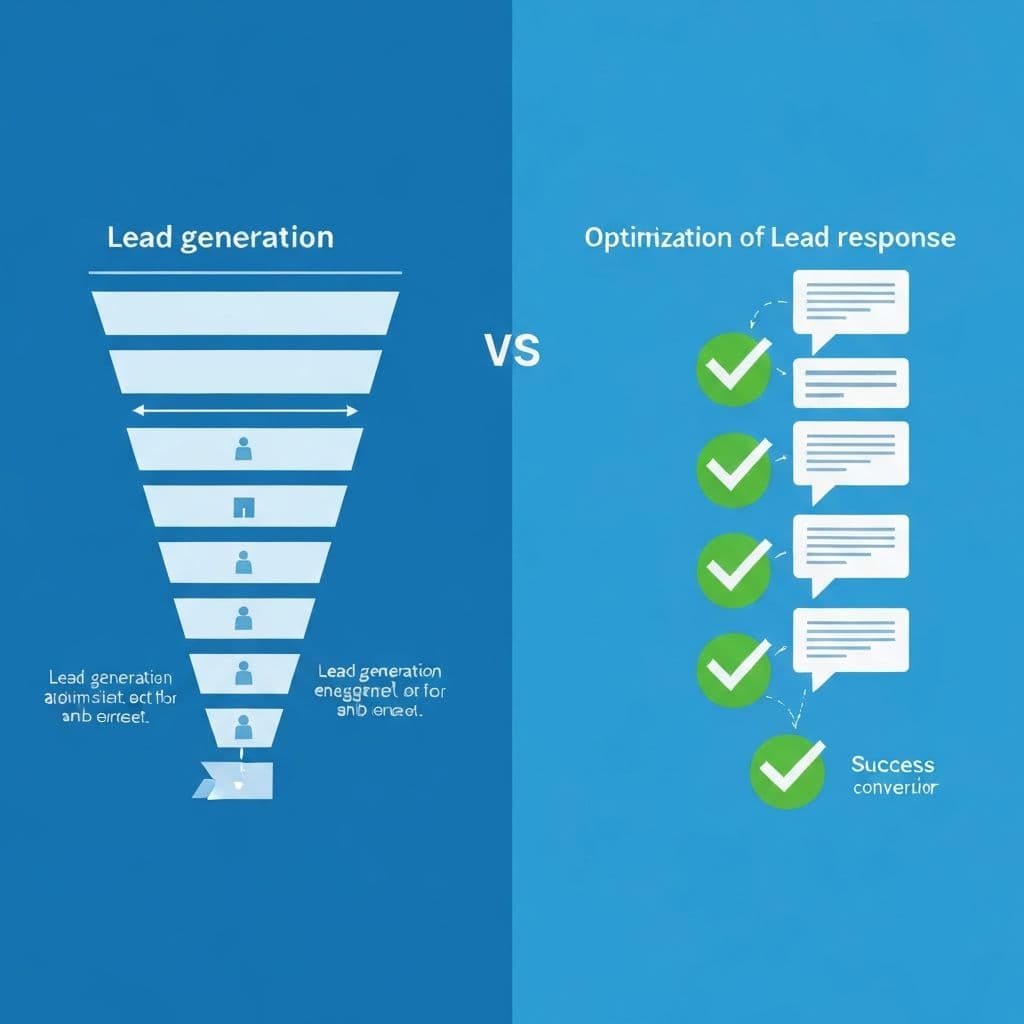
Solar Lead Generation vs Lead Response: Where Are You Actually Losing Revenue?
When a solar installation business is not growing at the rate the owner expects, the instinctive response is to spend more on lead generation. More search platforms Ads. More SolarQuotes credits. More Facebook campaigns. More leads coming in means more revenue going out — in theory.
But for most Australian solar installers, the revenue problem is not in lead generation. It is in lead response. The leads are coming in. They are being paid for. And then they are being lost — silently, invisibly, in the gap between enquiry submission and first contact.
Understanding the difference between solar lead generation and solar lead response, and knowing which one is actually limiting your revenue growth, is the most important diagnostic any solar business owner can run.
The Two Distinct Revenue Levers in Solar Sales
Solar revenue has two fundamental levers:
Lever 1 — Lead volume: How many new enquiries arrive per month. Influenced by marketing spend, platform presence, SEO, referrals, brand awareness.
Lever 2 — Lead conversion: What percentage of those enquiries become booked appointments, and then sales. Influenced primarily by response speed, qualification quality, and sales team effectiveness.
Most solar businesses over-invest in Lever 1 and under-invest in Lever 2. This creates a situation where increasing the lead budget produces diminishing returns — not because the marketing is failing, but because the conversion engine it is feeding is leaking.
The symptom: a business increases its SolarQuotes spend from $5,000 to $10,000 per month and sees revenue increase by less than 50%. The diagnosis: the conversion rate did not improve, so more leads produced proportionally more revenue — but the money that should have been gained by fixing the conversion gap was left on the table.
Where the Lead Response Gap Actually Lives
To understand where solar revenue is being lost, you need to map the journey of a typical lead from submission to sale — and identify exactly where leads drop out.
The Solar Lead Journey
1. Homeowner submits solar enquiry (website form, SolarQuotes, Facebook Lead Ad)
         ↓
2. Lead arrives in installer's CRM or inbox
         ↓
3. [GAP: Response time — this is where most revenue is lost]
         ↓
4. Installer calls lead for first time
         ↓
5. Qualification conversation (property, bill, ownership, battery interest)
         ↓
6. Appointment booked
         ↓
7. Consultant attends, presents proposal
         ↓
8. Close
The gap at step 3 is where the most revenue disappears. It is not the only point of loss — qualification quality, appointment show rate, and close rate all matter — but the response time gap is the single point where the largest percentage of leads are permanently lost.
Research from Demand Local shows the conversion rate difference between responding in under five minutes (20–28%) versus waiting 24 hours (2–5%) is roughly a ten-fold difference. For a business spending $10,000/month on 100 leads at $100 each:
- Five-minute response: 20–28 appointments from 100 leads
- 24-hour response: 2–5 appointments from 100 leads
The marketing spend is identical. The revenue outcome is four to ten times different.
A Revenue Diagnostic: Lead Generation vs Lead Response
The following exercise will tell you whether your solar business has a lead generation problem or a lead response problem.
Step 1: Calculate Your Current Lead-to-Appointment Rate
Pull three months of data from your CRM:
- Total leads received
- Total appointments booked from those leads
Divide appointments by leads. If your rate is below 20%, you almost certainly have a lead response problem rather than (or in addition to) a lead generation problem.
Step 2: Calculate Your Average Response Time
For the same three months, calculate:
- Average time between lead submission and first contact attempt
- Percentage of leads not contacted within 2 hours
- Percentage of leads submitted outside business hours — and what percentage of those were contacted within 24 hours
If your average response time is over 30 minutes, or if your after-hours contact rate is below 80%, you have a response problem. To compare yourself to top performers, see the latest solar lead response time benchmarks.
Step 3: Compare Your Lead Sources
Not all lead sources produce equal response windows. Analyse:
- Which lead source produces your highest conversion rate?
- Is there a pattern linking high-converting lead sources to faster response (e.g., website leads you call immediately versus SolarQuotes leads where you check the inbox every few hours)?
Often, the lead sources that appear to produce better leads are simply the ones that trigger faster response.
The Economics of Lead Response vs Lead Generation Investment
| Scenario | Monthly Lead Spend | Leads | Avg Response | Conv Rate | Appointments | Revenue Potential |
|---|---|---|---|---|---|---|
| High gen, slow response | $20,000 | 200 | 3 hours | 8% | 16 | $112,000 |
| High gen, fast response | $20,000 | 200 | 8 seconds | 30% | 60 | $420,000 |
| Low gen, fast response | $10,000 | 100 | 8 seconds | 30% | 30 | $210,000 |
| Low gen, slow response | $10,000 | 100 | 3 hours | 8% | 8 | $56,000 |
Assumptions: 65% appointment-to-close rate, $10,000 average job value. Response times based on LeadTrackAI platform data and industry benchmarks.
The table above makes the economics clear. Doubling lead generation spend while maintaining a slow response produces $112,000 in revenue potential. Maintaining existing lead generation spend while fixing response speed produces $210,000 — 87% more revenue at half the marketing cost.
The highest-revenue scenario is both high lead volume and fast response — but if you have to choose where to invest first, fixing the response engine before scaling the lead generation volume is the higher-ROI decision for most solar businesses.
Stop Paying for Leads You Are Not Responding To Fast Enough
LeadTrackAI responds to every solar enquiry in under 10 seconds — Voice, SMS, and Email — 24/7. The platform pays for itself within days, not months. [Book your free demo → leadtrackai.io/demo]
The Most Common Signs of a Lead Response Problem
Solar business owners often attribute poor conversion to lead quality rather than response speed. Here are the most reliable indicators that the real issue is response:
Sign 1: High lead volume, low appointment rate If you are receiving 100+ leads per month but booking fewer than 15–20 appointments, your conversion rate (15–20%) is below what a fast-response system typically achieves. This is rarely a lead quality problem — it is a speed problem.
Sign 2: After-hours leads rarely become customers If you track which leads ultimately closed and find that very few were submitted outside business hours, this is strong evidence that your after-hours contact rate is poor. The homeowners who enquired on Saturday are not somehow lower quality — they are just not being called back in time.
Sign 3: Leads say they have already spoken to another company When your team finally reaches a lead that came in two to six hours ago and is told "we are already talking to someone else," that is the lead response gap made visible. It is a common experience for manual-response solar sales teams.
Sign 4: Lead source performance seems to vary unpredictably When some lead sources appear to perform much better than others without an obvious explanation, check whether those sources produce faster internal response. Often, the "better lead source" is simply one where the team sees the notification more quickly.
Sign 5: You are spending more on generation but revenue is not growing proportionally If doubling your lead budget produces less than double the revenue, the constraint is not lead volume — it is conversion. Fixing response speed before scaling spend is the right sequence.
When Lead Generation Actually Is the Problem
It would be misleading to suggest that lead generation never needs attention. There are genuine scenarios where the primary constraint is lead volume rather than conversion:
- A business with an extremely fast response system (under 60 seconds) that is still not generating enough appointments to fill the sales team's capacity — more leads will produce more revenue
- A new business in a low-competition area where the addressable market is large and untapped
- A business targeting commercial solar where the lead pool is inherently smaller and requires active prospecting rather than inbound lead buying
The diagnostic test is simple: if your conversion rate is already at 25–30% or above, lead volume is probably the constraint. If your conversion rate is below 15%, lead response almost certainly needs attention first.
Combining Lead Generation and Lead Response: The Optimal Model
The highest-performing solar companies do not see lead generation and lead response as competing priorities. They treat them as sequential investments: fix conversion first, then scale volume.
The sequence works like this:
- Implement AI solar lead response automation — achieve under-60-second response on all channels, 24/7
- Measure the conversion rate improvement — typically a doubling or tripling of lead-to-appointment rate. The right solar lead management software makes this measurable.
- Scale lead generation spend — now every additional lead is being converted at the optimised rate, producing maximum ROI on marketing spend
This sequence means that every dollar spent on marketing after the response engine is fixed produces significantly more revenue than the same dollar spent before it. The compounding effect of this approach is what drives the $2.3M revenue recovery figure that LeadTrackAI reports as an average client outcome — not by generating more leads, but by converting the leads already being bought.
The Role of Battery Storage in Lead Response Strategy
The federal battery rebate — now $7.2 billion in funding under the Cheaper Home Batteries Program — has created a specific urgency window that makes lead response even more critical in 2026. With rebates on batteries over 14kWh set to drop approximately 20% from May 1, 2026, leads with battery interest have a time-sensitive decision context.
An AI qualification system that identifies battery interest in the first 90 seconds of contact, and flags those leads for priority human follow-up with rebate-specific information, converts at significantly higher rates than generic follow-up. The combination of speed (responding in seconds) and relevance (immediately addressing the rebate context) turns a standard enquiry into a high-urgency conversation.
Solar businesses that are not systematically identifying and acting on battery interest in their lead qualification process are leaving a significant portion of their highest-value conversion opportunities on the table.
Qualify Every Battery Lead Before the Rebate Deadline
LeadTrackAI's solar qualification scripts identify battery storage interest automatically and flag high-value prospects for priority follow-up — all within the first 8 seconds of contact. [Book your free demo → leadtrackai.io/demo]
Frequently Asked Questions About Solar Lead Generation vs Lead Response
How do I know if my problem is lead quality or response speed?
The clearest test: take 20 of the leads your team considers "low quality" or "unresponsive" and call them all within five minutes of their original submission time (if you have time-stamped records). If a significantly higher percentage engage with a same-day call than your historical average suggests, the issue is response speed, not quality.
Does fixing lead response speed mean I should spend less on lead generation?
Not necessarily. Improving response speed typically improves your ROI on existing lead spend, not reduces it. Once response is optimised, scaling lead generation becomes a more efficient investment because more of each lead dollar converts to revenue.
Are SolarQuotes and Solar Choice leads worth buying?
They can be, particularly if you have a fast response system. The challenge with shared platforms is that your lead is distributed to multiple competitors simultaneously. Without a sub-60-second response capability, the economics of shared leads are genuinely difficult. With AI-powered response, the same leads produce dramatically better results.
What is a realistic lead-to-appointment conversion rate for solar?
With a manual response system and average response times, 8–15% is typical. With AI-powered instant response, 25–35% is achievable on the same lead volume. Top-performing solar businesses with optimised response systems report rates above 30%.
How does after-hours lead response affect annual revenue specifically?
For a business receiving 200 leads per month with 40% arriving after hours (80 leads), if those leads are not contacted until the next morning, at a 5% next-day conversion rate, you are booking four appointments. The same 80 leads with instant AI response at 25% conversion produces 20 appointments. That difference — 16 extra appointments — at a 65% close rate and $10,000 average job is $104,000 per month in additional revenue, or $1.25 million annually.
Is there a meaningful difference between a human and AI first call for solar leads?
The data suggests that for initial qualification, AI performs comparably to or better than human first-contact callers — primarily because AI is consistent, always available, and never has a bad day. The human advantage becomes pronounced at the consultation and closing stages, where relationship and technical skills matter. The optimal model combines AI for first contact and human for consultation.
Conclusion
The solar lead generation vs lead response debate has a clear answer for most Australian installers: the largest single revenue opportunity in the average solar business is not buying more leads — it is converting more of the leads already being purchased. Lead response speed, after-hours coverage, and qualification consistency are the three variables that determine conversion rate, and all three are addressable with AI automation at a fraction of the cost of manual staffing.
Investing in lead response before scaling lead generation is not a conservative strategy. It is the approach that produces the highest return per dollar invested, the fastest. Once the response engine is performing at its potential, scaling lead volume amplifies the result. Until then, every additional marketing dollar is converting at a fraction of its potential.
The solar companies that understand this distinction — and act on it — are capturing both the appointments and the revenue that their competitors are paying for but failing to convert. Explore how AI for solar sales teams is reshaping this end-to-end, or see purpose-built solar lead management software for Australian installers.
About the Author
Robert SullivanSolar Industry Specialist
15+ years Solar Installation | Lead Qualification | Business Growth
Robert brings 15 years of solar installation experience combined with lead automation expertise. He focuses on systems that improve installer profitability.
See LeadTrackAI in your workflow
Request a personalised demo and we will follow up with the most relevant next step for your team.
Request a DemoKeep Reading
Explore related articles to deepen your understanding of lead automation and sales optimization.

How to Automate Solar Lead Response and Book More Appointments in 2026
Solar lead response automation can 3x your appointment bookings. Learn how Australian installers are using AI to respond to every enquiry in under 10 seconds.

Best Solar Lead Management Software for Australian Installers in 2026
Comparing the best solar lead management software available to Australian installers in 2026. From CRM integrations to AI follow-up, here's what actually moves the needle on conversion.

How AI Is Transforming Solar Sales Teams in Australia in 2026
AI for solar sales teams is reshaping how Australian installers qualify leads, book appointments, and close deals. Here's what every solar sales leader needs to know.

Lead Response Time Benchmarks: What Top Solar Companies Do Differently in 2026
What are the lead response time benchmarks for Australian solar companies in 2026 — and where does your business stand? Real data from 50,000+ leads.
Revenue Recovery Calculator
Monthly Revenue Recovery
$0
Based on 600 leads × 15% lift × $3,500 job value